 Bradenton Siding
 Lakewood Ranch homes take a different kind of beating than a house forty miles inland. Between the intense Gulf Coast sun, the wind-driven rain that comes through during summer storms, and the salt-tinged air that drifts in off Sarasota Bay and Tampa Bay, exterior siding here ages faster than most manufacturers' spec sheets assume. We install James Hardie fiber cement siding exclusively, and this page walks through what that means specifically for a Lakewood Ranch property — not siding in general, but the product, the process, and the reasoning behind both.
Why Lakewood Ranch Siding Takes More Punishment Than It Looks Like
Lakewood Ranch sits in Manatee County, close enough to the coast that salt air is a real factor even though it doesn't feel "beachfront." Salt-laden moisture settles on exterior surfaces, works into seams and fastener points, and accelerates corrosion and material breakdown over years of exposure. Add in a Florida sun that delivers UV intensity year-round, not just in summer, and you've got a climate that tests two things above all else: how well a material resists moisture intrusion, and how well its finish holds color and integrity under constant UV load.
Then there's wind. Manatee County sits in a hurricane-exposed region, and even in a "normal" storm season, homes here see sustained high winds and horizontal, wind-driven rain multiple times a year. That combination — wind pressure plus saturating rain — is where cheaper siding systems and poor installations get exposed. Water doesn't need a hurricane to find a gap; it needs one heavy afternoon storm pushed sideways by a 40 mph gust.
What This Means in Practice
- Siding needs to be non-combustible and structurally stable under wind load, not just weather-resistant on paper.
- Factory-applied color finish matters more here than in milder climates, because UV fade and chalking show up faster.
- Every seam, joint, and fastener point is a potential moisture entry point — installation precision matters as much as the product itself.
- Ground-level and lower-wall siding near landscaping or sprinkler zones needs proper clearance to avoid chronic moisture contact.
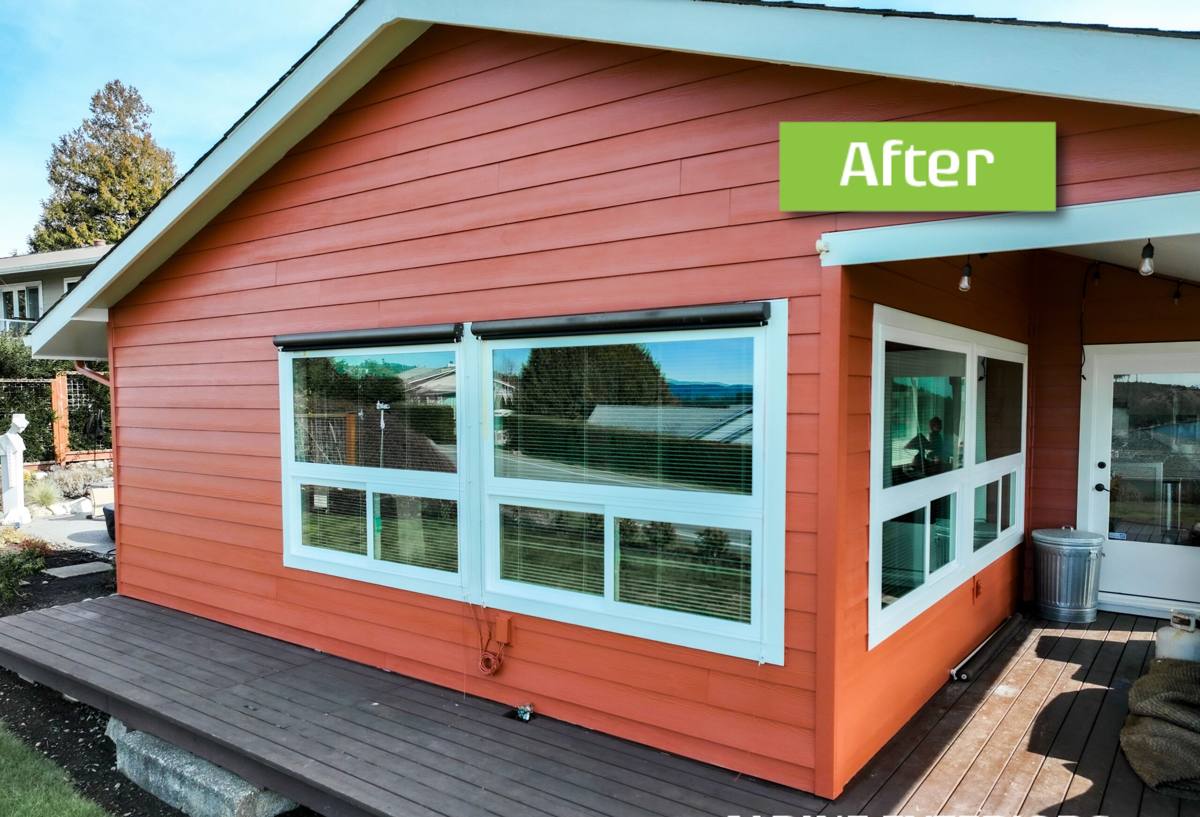
Why We Install Only James Hardie Fiber Cement
We don't install vinyl, LP SmartSide, primed wood, or other fiber cement brands. That's a deliberate standard, not a sales pitch, and it's worth explaining honestly. Vinyl siding can warp and deform in sustained high heat and is more vulnerable to wind uplift in storm-force gusts. Wood-based and engineered wood products are more sensitive to moisture intrusion at cut edges and seams — exactly the kind of exposure Gulf Coast wind-driven rain creates. Other fiber cement brands may perform reasonably well, but we've standardized on James Hardie specifically because of its factory-baked ColorPlus finish, its HZ5 formulation engineered for high-humidity, storm-prone climates, and a warranty structure that's transferable and well-documented.
James Hardie fiber cement is non-combustible, dimensionally stable in heat and humidity swings, and doesn't rely on a field-applied topcoat that can fail at the finish level even when the substrate underneath is fine. For a Lakewood Ranch home facing sun, salt, and wind in combination, that's the profile we want on the wall — not the cheapest option that meets a minimum spec.
The HZ5 Product Line and Why the "HZ" Rating Matters Here
James Hardie engineers its siding in different formulations for different climate zones, and Manatee County falls into the HZ5 zone — the line built specifically for regions with high humidity, heavy rain exposure, and hurricane risk. This isn't a marketing distinction. The HZ5 formulation is engineered to resist moisture-related issues that show up disproportionately in Gulf Coast and Southeast climates, which is exactly the exposure profile Lakewood Ranch sees year after year.
Installing an HZ5-rated product with the correct fastening pattern, clearances, and flashing details is what actually delivers the performance the product is engineered for. A correct product installed incorrectly will still fail early — which is why we treat installation method as inseparable from product selection.
Common James Hardie Product Choices for This Area
| Product | Best Use | Why It Fits Lakewood Ranch |
|---|---|---|
| HardiePlank Lap Siding | Most home exteriors | Traditional profile, ColorPlus finish holds up under constant UV |
| HardiePanel Vertical Siding | Accent walls, gables, modern facades | Clean lines, strong moisture resistance at panel joints when properly flashed |
| HardieTrim Boards | Corners, fascia, window/door trim | Resists the swelling and rot that wood trim suffers in humid coastal air |
| HardieSoffit Panels | Eaves and overhangs | Withstands moisture buildup in shaded, poorly ventilated areas |
What a Correct Installation Actually Involves
Most siding failures we get called out to inspect aren't product failures — they're installation failures. James Hardie publishes detailed fastening, clearance, and flashing specifications, and skipping or shortcutting them is what turns a 30-plus-year product into a 10-year problem. For Lakewood Ranch specifically, a few details matter more than they would in a drier, calmer climate:
- Weather-resistive barrier and flashing: A correctly lapped, sealed water-resistive barrier behind the siding is the actual first line of defense — the siding sheds most water, but the barrier handles what gets past it.
- Proper fastener spacing and type: Under-fastening or using the wrong fastener type reduces wind resistance exactly where hurricane-force gusts will find the weak point.
- Correct clearances: Siding needs proper clearance from the roofline, decks, and grade — closing that gap traps moisture against the bottom edge of the boards.
- Joint and seam treatment: Butt joints and panel seams need to be treated per spec, not just butted and caulked, to prevent water intrusion at the most vulnerable points.
- Caulking and sealant at penetrations: Every fixture, vent, and utility penetration through the siding is a potential leak point if sealed incorrectly.
Our Process for a Lakewood Ranch Fiber Cement Job
1. On-Site Assessment
We look at your home's existing siding condition, sheathing and substrate condition underneath, sun exposure on each elevation, and any specific wind or moisture exposure tied to your lot — corner lots and homes near open water or golf course frontage often see more direct wind load.
2. Product and Color Selection
We walk through the HZ5 product options relevant to your home's design, along with ColorPlus finish colors, so you're choosing based on what actually fits your house and HOA requirements, not a generic catalog.
3. Tear-Off and Substrate Check
Old siding comes off, and we inspect the sheathing underneath for any moisture damage before anything new goes up. Installing new siding over compromised substrate just hides a problem instead of fixing it.
4. Barrier, Flashing, and Installation
Weather-resistive barrier goes on correctly lapped and sealed, flashing is installed at every transition point, and the Hardie product is installed to manufacturer fastening and clearance spec — not a shortcut version of it.
5. Trim, Caulk, and Final Inspection
Trim and penetration points get sealed, and we do a final walk-through so you understand what was done and why.
Sun, Color, and the ColorPlus Finish
Bradenton and Lakewood Ranch get intense, near-constant sun exposure across most of the year, and that's hard on any painted or coated exterior surface. James Hardie's ColorPlus Technology is a factory-applied, baked-on finish rather than a field-applied paint job, and it's engineered specifically to resist the fading and chalking that heavy UV exposure causes over time. That matters for a straightforward reason: a finish that fades unevenly across sun-exposed and shaded elevations makes a house look tired years before the underlying siding is actually due for attention.
Maintenance: What Lakewood Ranch Homeowners Should Actually Expect
Fiber cement is genuinely low-maintenance, but "low" isn't "zero," especially in a coastal-adjacent climate. Here's what reasonable upkeep looks like:
| Task | Frequency | Why It Matters Locally |
|---|---|---|
| Rinse siding with a garden hose | Every few months | Removes salt residue and airborne grime before it builds up |
| Inspect caulking at joints and trim | Annually | UV and heat cycling can dry out sealant faster than in milder climates |
| Check for gaps at penetrations | Annually, or after major storms | Wind-driven rain finds even small gaps during storm events |
| Trim landscaping away from siding | As needed | Reduces trapped moisture and irrigation overspray against lower panels |
Why Hiring a Crew That Already Works Lakewood Ranch Matters
Installation quality is the single biggest variable in how long siding actually lasts, and installers who work this specific area regularly understand things a generalist crew won't — how HOA architectural review processes tend to run in planned communities like this one, what wind exposure looks like on open lots versus more sheltered interior streets, and how to sequence a job around Florida's afternoon storm patterns instead of getting caught mid-installation with panels exposed. A crew that's done this work locally, repeatedly, isn't guessing at any of that.
We're also James Hardie–focused by design, which means our crews aren't splitting attention across five different siding systems with five different installation methods. One product, installed correctly, consistently — that's the whole model.
A Straightforward Checklist Before You Hire Anyone
- Ask what siding brand and product line they're proposing, and whether it's rated for your climate zone (HZ5 for this area).
- Ask to see their fastening and clearance approach — a contractor who can explain this in detail is one who follows it.
- Confirm whether they inspect and address substrate/sheathing condition before installing new siding.
- Ask how they handle flashing at windows, doors, and roof transitions specifically.
- Get manufacturer warranty details in writing, and understand what workmanship warranty the contractor themselves provides.
Get a Local, No-Pressure Estimate
If your Lakewood Ranch home's siding is showing sun damage, chalking, soft spots, or you're just planning ahead of the next storm season, we're happy to take a look and walk you through what James Hardie fiber cement would involve for your specific house — no pressure, no generic sales pitch. Use the form below to request a free estimate.