 Bradenton Siding
 Siding Built for Samoset's Corner of Manatee County
Samoset sits in one of the older, well-established residential pockets of the Bradenton area, with a housing stock that spans mid-century ranch homes to newer infill construction. What almost every house here has in common is exposure to the same set of Gulf Coast stressors: long stretches of intense UV, humidity that never really lets up, wind-driven rain during the summer storm season, and a steady dose of salt-laden air moving in off the water. Siding in this part of Manatee County isn't just cosmetic — it's the first line of defense against moisture intrusion, wood rot, and the slow cosmetic breakdown that shows up as chalking, fading, and cracked caulk lines within a few short years of a lower-grade install.
We work Samoset regularly as part of our broader Bradenton service area, and we bring the same standard to every house: James Hardie fiber cement siding, installed to manufacturer spec, and nothing else. That's not a marketing angle — it's a decision we made after years of watching which products actually hold up on this coastline and which ones create callbacks.
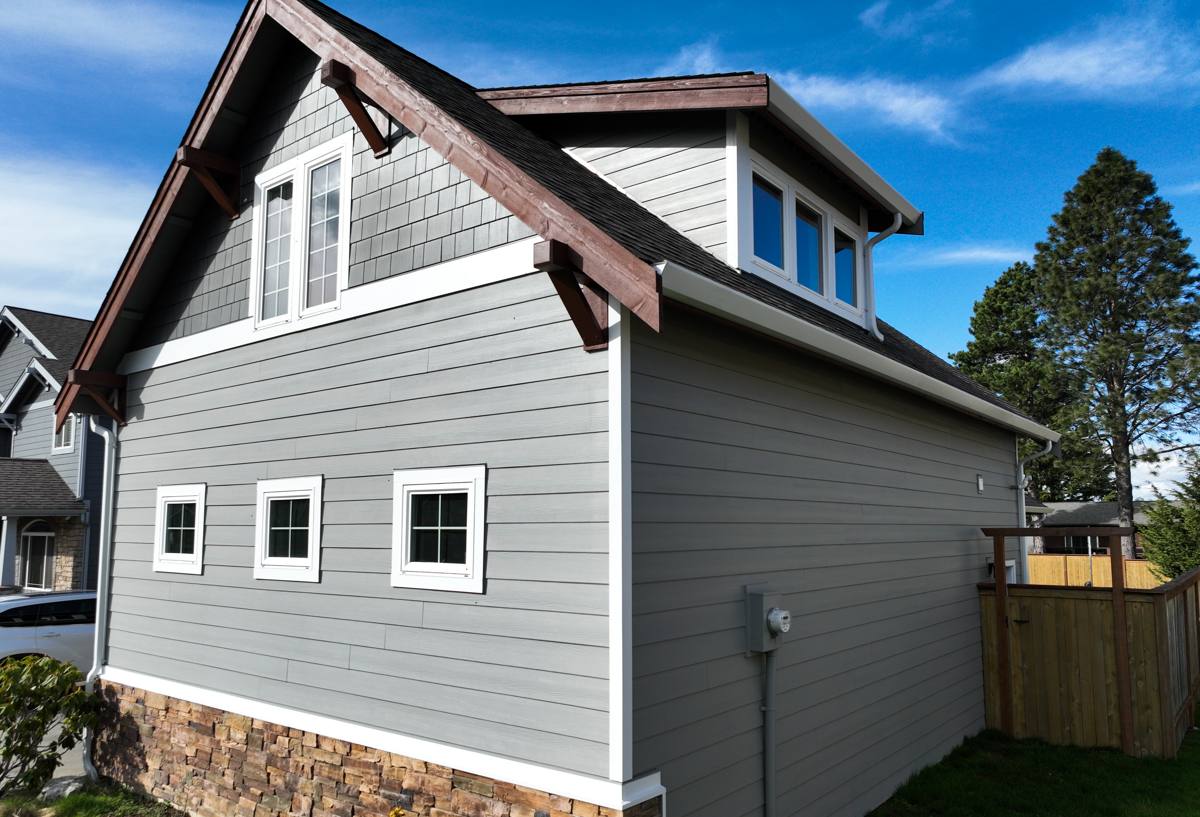
What Samoset Homes Are Actually Up Against
Heat and UV Load
Bradenton gets some of the most consistent, high-intensity sun exposure in the country. Painted wood and lower-grade composite sidings absorb that UV load directly, which accelerates fading, breaks down surface coatings, and dries out caulking at the joints and trim. Over a few years that turns into a chalky, uneven finish and hairline cracks that let water behind the panel.
Humidity and Moisture Cycling
Manatee County's humidity doesn't just sit in the air — it drives constant expansion and contraction in siding materials, especially wood-based products. Materials that swell when wet and shrink when they dry out eventually loosen fasteners, open seams, and warp. That cycle is one of the main reasons wood and engineered-wood sidings need more frequent recaulking and repainting on the Gulf Coast than they do inland.
Wind-Driven Rain
During the summer storm season, rain in this area rarely falls straight down — it comes in sideways, driven by wind, and gets forced into every gap, lap joint, and fastener hole a siding system has. Products with weaker moisture resistance or less forgiving installation tolerances are far more likely to let water behind the cladding during these events, where it can sit against sheathing and framing unnoticed for months.
Salt Air
Even set back from the water, Samoset gets salt content in the air that accelerates corrosion on fasteners, trim, and any exposed metal components, and it contributes to the breakdown of lower-grade paints and coatings over time. Fiber cement doesn't corrode, and a factory-applied finish holds up to salt exposure far better than field-applied paint.
Why We Standardized on James Hardie — and Nothing Else
We don't install vinyl siding, LP SmartSide, Cemplank, Allura, or primed wood products like spruce or cedar. That's a deliberate professional standard, not a lack of options. Each of those products has legitimate strengths, but none of them hold up to Gulf Coast conditions as consistently as Hardie fiber cement, and we'd rather turn down work that doesn't match our standard than install something we know will create problems for a homeowner in five or ten years.
- Vinyl is affordable and low-maintenance, but it softens and warps under sustained heat, and high wind events can pry loose panels that aren't installed with tight tolerances.
- Wood-based composites like LP SmartSide use engineered wood strand cores that are moisture-resistant when new, but any breach in the factory coating — a nail pop, a cut edge, a scratch — creates an entry point where humidity and rain can start breaking the material down from the inside.
- Primed wood siding (spruce, cedar) is a real material with real character, but it's the most maintenance-intensive option on a coastline like this — repainting, recaulking, and moisture monitoring become a recurring cost, not a one-time job.
- James Hardie fiber cement is non-combustible, dimensionally stable across heat and humidity swings, and its ColorPlus finish is baked on at the factory rather than applied on-site, which gives it far better resistance to UV fading and salt exposure than field-applied paint.
Comparing the Options for a Samoset Climate
| Material | Moisture Behavior | UV/Salt Resistance | Typical Maintenance |
|---|---|---|---|
| Vinyl siding | Doesn't absorb water, but can warp or crack under heat and wind stress | Fades and becomes brittle with prolonged UV exposure | Low, but panels are prone to wind damage over time |
| LP SmartSide / engineered wood | Good when coating is intact; vulnerable once breached | Moderate; coating degrades with sustained humidity and UV | Periodic inspection and caulk/coating touch-up |
| Primed wood (spruce/cedar) | Absorbs and releases moisture; prone to swelling and rot | Requires repainting on a regular cycle | Highest — repainting, recaulking, moisture checks |
| James Hardie fiber cement | Dimensionally stable; engineered for high-moisture climates | Factory ColorPlus finish resists fading and salt exposure | Low — occasional rinse, no repainting on a fixed cycle |
Hardie Product Lines That Fit This Area
James Hardie makes climate-specific product lines, and the HZ5 formulation engineered for humid, high-moisture Southeast and Gulf Coast climates is what we spec for Samoset and the rest of the Bradenton area. Depending on the home's style, that typically means HardiePlank lap siding for a traditional look, HardieShingle for a more textured or coastal-cottage aesthetic, or HardiePanel for vertical or board-and-batten applications. All of them carry the same ColorPlus factory finish options and the same fiber cement core, so the choice comes down to the look you want, not a trade-off in durability.
What Correct Installation Actually Involves
Fiber cement performs the way it's supposed to only when it's installed to spec — this is a product where the installation matters as much as the material itself. On every Samoset project we follow James Hardie's published fastening, clearance, and flashing guidelines, which includes:
- Proper starter strip and clearance from grade, roofing, and other transitions to keep water from wicking into the bottom edge of the siding
- Correct nail spacing and fastener depth, since overdriven or underdriven fasteners are one of the most common causes of premature siding failure
- Sealed and flashed penetrations at every window, door, and utility penetration, using materials compatible with fiber cement
- Proper joint treatment at butt seams and corners so wind-driven rain can't work its way behind the panel
- A weather-resistant barrier behind the siding that's installed and lapped correctly, not just present
Skipping any one of these steps can void manufacturer warranty coverage and, more importantly, opens the door to the moisture problems fiber cement is otherwise very good at resisting.
Beyond Siding: The Rest of the Exterior
Siding rarely fails in isolation — it's usually one piece of an exterior envelope that includes the roof, windows, and any attached structures like a deck. We handle roofing, windows, and decks alongside siding work because they interact directly: a roof edge that isn't flashed correctly can send water straight down behind new siding, and window units that aren't properly integrated with the siding plane create the same risk. When we're on a Samoset property, we look at the whole exterior, not just the walls, so problems don't get patched over and reappear a year later somewhere else.
Why a Local Crew Matters Here
A crew that works Manatee County regularly knows the practical realities of building here — how quickly humidity moves in after a rain event, what wind-driven rain actually does to a poorly flashed joint, and how salt air factors into material choices over the life of a home. That local familiarity shows up in the details: correct clearances, attention to flashing at transitions, and product choices that are matched to this specific climate rather than a generic installation approach. It also means being reachable after the job is done — for warranty questions, for a follow-up inspection after a storm, or just to answer questions before you commit to anything.
A Simple Seasonal Checklist for Samoset Homeowners
- Rinse siding periodically to clear salt residue and airborne grime, especially after dry stretches followed by rain
- Walk the exterior after any significant wind event and look for loose, cracked, or displaced panels
- Check caulking at trim, window, and door transitions once a year — gaps are an early warning sign, not just a cosmetic issue
- Keep an eye on any wood-based siding or trim for soft spots, which indicate moisture has already gotten in
- Have your roof-to-wall flashing checked whenever you're having other exterior work done, since it's easy to overlook and hard to inspect from the ground
If you're weighing a siding replacement, or want a second opinion on a repair versus a full replacement, we're happy to walk the property with you and give you a straight answer. Request a free, no-pressure estimate using the form below and we'll get back to you with what we'd actually recommend for your home.