 Bradenton Siding
 Building Decks for Whitfield Estates' Coastal Conditions
Whitfield Estates sits close enough to Sarasota Bay and the Gulf that homes here deal with a specific combination of stressors most inland Florida neighborhoods don't face to the same degree: near-constant humidity, salt-laden air, intense UV exposure nearly year-round, and the real possibility of hurricane-force wind and wind-driven rain during storm season. A deck built without those factors in mind doesn't fail gracefully — it fails early, usually through fastener corrosion, board cupping, or a railing system that was never rated for the loads Manatee County code actually requires in a wind-exposed coastal zone.
We build custom decks for homes in and around Whitfield Estates and elsewhere in the Bradenton area, and the approach we use here reflects local conditions rather than a generic build spec pulled from a national materials catalog. That means specific fastener choices, specific footing depths, and specific attention to how a deck interfaces with an existing home's siding and flashing — because a poorly flashed ledger board is one of the most common ways water finds its way into a wall system on the Gulf Coast.
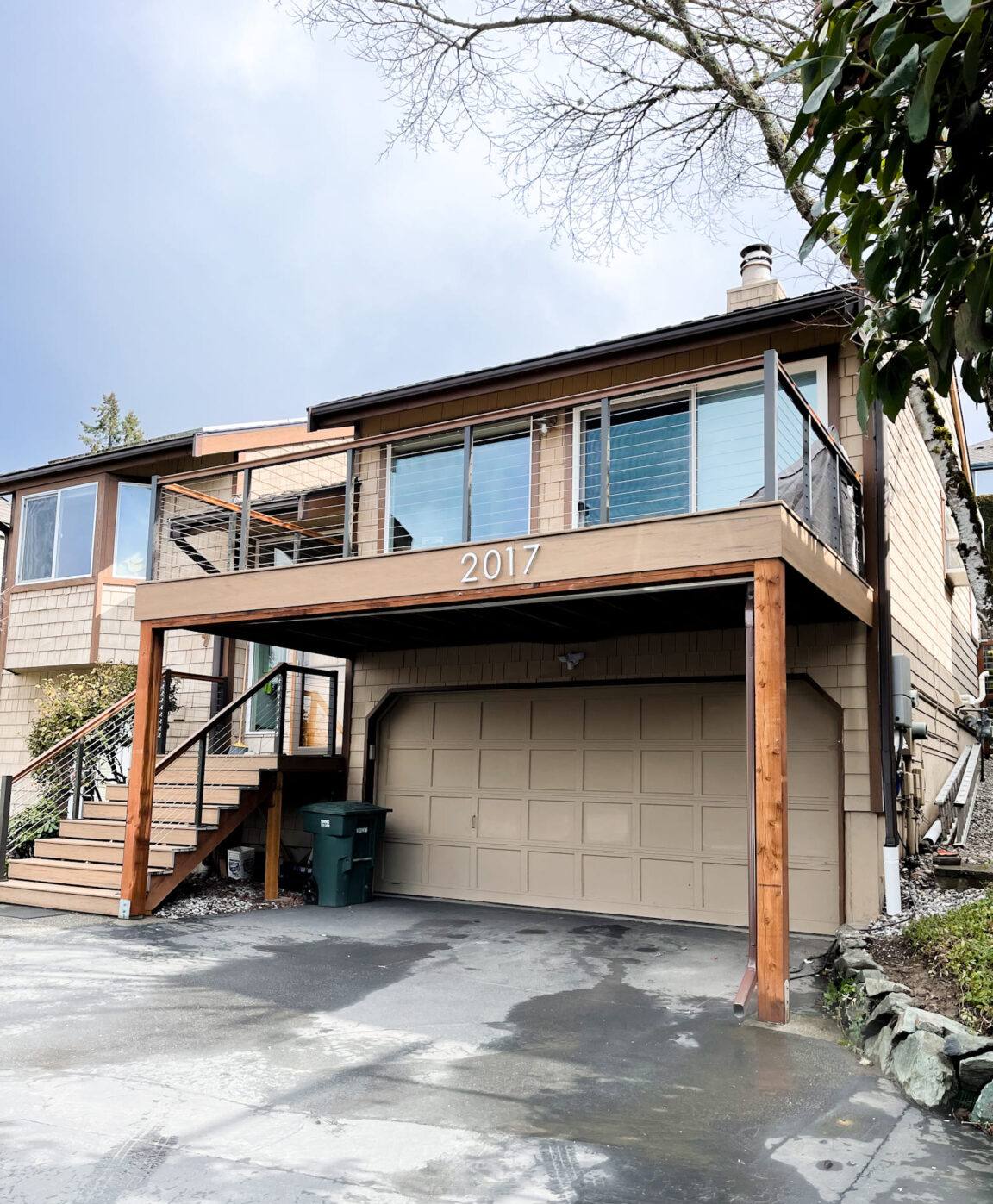
What Salt Air and Storm Wind Actually Do to a Deck
It helps to understand the failure modes before talking about materials, because every material and hardware decision on this page traces back to one of these problems.
Corrosion from Salt Air
Even a few miles from open water, airborne salt accelerates corrosion on any fastener, bracket, or connector that isn't rated for it. Standard electro-galvanized screws and joist hangers will rust and lose holding strength well before the wood around them shows visible wear. On a deck, that's a structural problem, not a cosmetic one — the connection between joist and ledger, or post and footing, is exactly where you don't want quiet, invisible corrosion happening over years.
UV Exposure
Manatee County gets strong, direct sun for most of the year. UV breaks down the lignin in wood fibers (turning untreated wood gray and brittle over time) and it also degrades lower-quality composite decking, causing fading, surface chalking, or in some products, warping from uneven heat absorption. Decking rated for UV stability performs very differently over a 10-year span than decking that isn't.
Wind-Driven Rain and Moisture Cycling
Florida decks don't just get rained on — they get rained on sideways, repeatedly, and then bake dry in full sun within hours. That wet-dry cycling is harder on wood and fasteners than constant moisture would be, because it drives repeated expansion and contraction. Ledger connections, end grain, and any spot where water can pool (rather than shed) are where this shows up first.
Wind Uplift and Structural Loads
During tropical storms and hurricanes, a deck attached to a house isn't just holding up foot traffic — it's resisting uplift and lateral wind loads, and if it's poorly attached, it can become a lever that pulls at the house structure itself. Railing systems in particular need to meet code-required load ratings, not just look sturdy.
What a Correctly Built Deck Looks Like Here
For Whitfield Estates and similar Bradenton-area properties, a deck that's actually built for the conditions includes the following, as a baseline — not upgrades, but the standard we work to:
- Stainless steel or coated, coastal-rated fasteners and structural connectors at every joint — never standard interior-grade hardware
- Properly flashed ledger board attachment with a moisture barrier between the ledger and the house structure
- Footings sized and set to local frost-free, wind-zone requirements, not a minimum national default
- Decking material chosen for UV stability and moisture performance, not just upfront cost
- Railing and guard systems that meet Florida Building Code load requirements for the applicable wind zone
- Fastener spacing and joist layout that accounts for the specific decking product's expansion characteristics
- Proper drainage and airflow underneath the deck structure to prevent trapped moisture
Skipping any one of these doesn't necessarily cause an obvious problem in year one. It shows up in year three or four, usually as a soft spot, a rust-streaked board, or a railing that's developed play in the connection. That's the deck asking to have caught the issue at the ledger flashing stage, not the deck stage.
Choosing Materials: What Actually Holds Up Here
There's no single right decking material for every homeowner — it comes down to budget, maintenance tolerance, and how the deck will be used. What matters is picking with eyes open, especially in a coastal-influenced climate.
| Material | How It Performs in Coastal Bradenton Conditions | Maintenance Reality |
|---|---|---|
| Pressure-treated pine | Affordable, structurally solid when properly fastened; more prone to UV graying and moisture movement without upkeep | Needs sealing/staining every 1-2 years to hold up against sun and rain |
| Composite decking (quality lines) | Strong UV and moisture resistance when the product is genuinely rated for high-sun climates; consistent performance over time | Low — periodic cleaning, no staining or sealing |
| Tropical hardwoods (e.g., ipe) | Naturally dense and rot-resistant, handles moisture cycling well | Moderate — periodic oiling to maintain color, though structurally durable even if left untreated |
| Budget composite/PVC blends | Inconsistent — some lower-tier products chalk, fade unevenly, or warp under sustained heat and UV | Varies widely by manufacturer; warranty terms matter more than the marketing |
We'll walk through these tradeoffs honestly during an estimate rather than steering every homeowner toward the highest-margin product. Some homeowners want the lowest lifetime maintenance and are fine paying more upfront for it; others are comfortable with a periodic staining routine in exchange for a lower initial cost. Both are reasonable choices when the underlying structure is built correctly.
Our Process for a Whitfield Estates Deck Project
1. On-Site Assessment
We look at the attachment point to your home, existing grade and drainage, sun exposure, and how you actually plan to use the space — entertaining, grilling, a quiet spot off a bedroom, pool access. This shapes layout and material recommendations more than any generic template would.
2. Design and Material Selection
We go over decking, railing, and finish options with real cost and maintenance tradeoffs, not just a catalog handoff. If your HOA in Whitfield Estates has architectural guidelines, we'll work within them rather than presenting a design that has to get reworked later.
3. Permitting
Deck construction in Manatee County typically requires a permit, and coastal wind-zone requirements affect footing depth, post sizing, and railing specs. We handle the permit process as part of the job so you're not the one tracking down inspections.
4. Structural Build
Footings, framing, ledger attachment, and flashing come first — this is the part that determines how the deck performs in year five and year fifteen, even though it's the least visible part of the finished product.
5. Decking, Railing, and Finish
Surface material and railing go on last, along with any stairs, lighting, or finish details discussed during design.
6. Final Walkthrough
We walk the finished deck with you, confirm everything matches what was agreed on, and go over any maintenance recommendations specific to the material you chose.
Why Local Experience in Whitfield Estates Matters
A contractor who mostly works inland, or mostly works in a different climate region, doesn't necessarily know to spec stainless fasteners as a default, or to think through how salt air will treat a standard galvanized joist hanger over a decade. That knowledge comes from having built and maintained decks specifically in Gulf Coast, wind-exposed neighborhoods — understanding what Manatee County inspectors actually check for, what the local wind zone requirements mean for footing and railing design, and which materials genuinely hold up under this specific combination of sun, salt, and storm exposure versus which ones just look fine in a showroom.
We also know the practical side of working in an established neighborhood like Whitfield Estates — respecting property lines, keeping a job site clean and considerate of neighbors, and being straightforward about timeline, since Florida's rainy season can affect outdoor construction scheduling.
A Quick Pre-Project Checklist for Homeowners
Before you get quotes for a deck project, it helps to have thought through a few things:
- Roughly how you'll use the deck (dining, lounging, grilling, pool access) — this affects size and layout
- Whether your HOA has design or material restrictions
- Your maintenance preference: lower upfront cost with periodic upkeep, or higher upfront cost with less ongoing work
- Whether you want the deck to tie into existing outdoor living features (pool deck, patio, outdoor kitchen)
- Any known drainage issues in your yard that could affect footing placement
Having rough answers to these speeds up the design conversation and helps us give you a more accurate estimate on the first visit.
Maintenance After Installation
Whatever material you choose, a few habits go a long way in this climate: keep debris and standing water off the deck surface, rinse off salt residue periodically if you're close to the water, check railing connections annually, and address any soft spots or discoloration early rather than waiting. A deck built correctly from the start needs far less intervention than one where problems were allowed to compound.
If you're considering a custom deck for your Whitfield Estates home, we're happy to walk the property, talk through material options honestly, and give you a straightforward, no-pressure estimate. Use the form below to get started.